Alberte's Bicycle
The Hanging GirlAlberte's Bicycle links the physical scene of Alberte Goldschmid’s fatal collision to the later investigation and to an artwork built around the case. Found far from the apparent point of impact, it becomes a focus of reconstruction; transformed into a sculpture, it carries the investigation’s scattered details into a new setting. Yet neither its dramatic position nor the fragments associated with it settle how the collision was caused or who was responsible.
Recovery and Scene Reconstruction
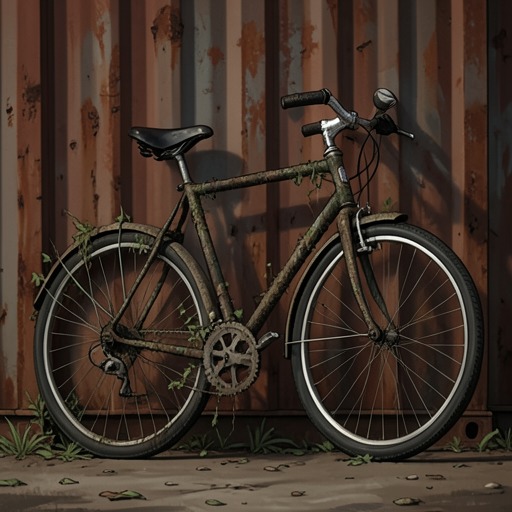
The bicycle was found in dense undergrowth beneath a group of trees, across a track from the investigators’ position. Its distance from the presumed impact point struck Carl Mørck as unusual. The location mattered because the bicycle’s position could be read as part of the collision’s trajectory, but it was not itself proof of precisely how the events unfolded.
The reconstruction proposed that Alberte had left the bicycle standing on its kickstand and gone to meet a car. On this account, the vehicle hit her first and then struck the bicycle, throwing both into the air. The bicycle was thought to have been flung in a more oblique direction than Alberte. This explanation gives the recovered object a place in a sequence of impacts, while remaining an interpretation of the scene rather than a direct observation of the collision.
The absence of obvious leads at the scene sharpened the uncertainty. Carl asked whether the death was certainly traffic-related, what the postmortem injuries established, and what had been found where the collision occurred. He also questioned why investigators had no leads from the collision, asking about skid or tire marks and whether it had rained. His questions frame the bicycle as one part of an incomplete evidentiary picture: its location invited a theory, but missing or inconclusive traces limited what could be established.
The Bicycle as Evidence
Christian Habersaat’s case materials included a precise plan showing a tree, the road beside it, and the bicycle in the thicket. The plan was thought likely to have been drawn by technicians rather than by Habersaat himself, because of its precision. Another piece of material, described as a splinter, lay in a straight line between the recovered bicycle and the place where the collision was understood to have occurred. The line and the splinter’s placement made it relevant to the proposed route of the impact, but did not by themselves identify the vehicle or prove the reconstruction.
The material evidence remained unsettled. The splinter was identified as birch, while closer analysis could not determine with certainty whether it came from the same board as another piece under examination. Later, technicians confirmed that the splinter was plywood, but established that a board recovered from the water was not the board that had thrown Alberte into a tree. They also found that the boreholes Habersaat described could not have attached that board to a Volkswagen Kombi in the proposed way. Hooks through the holes were raised as a possible alternative, but the account presents the attachment point as an unresolved technical question. The distinction between a fragment that could be characterized and a board that could be matched to a vehicle proved crucial: the bicycle’s position supported investigation, but the available material did not complete the chain of proof.
Transformation into a Sculpture
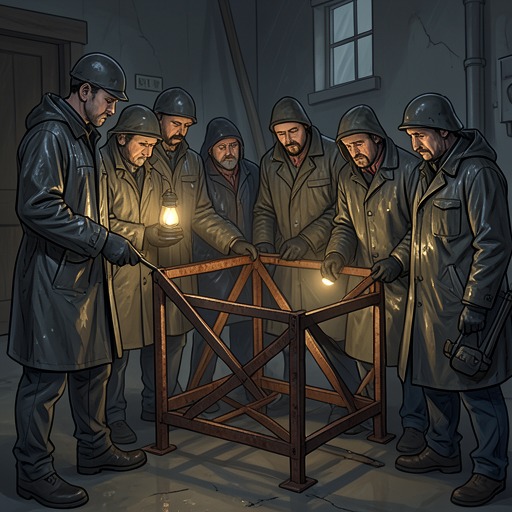
The bicycle later became the base of a sculpture associated with the case. Its wheels were buckled and its handlebars twisted; reinforced crossbars had been welded to the frame and projected outward like rays. Evidence relating to particular details of the case hung from the ends of the bars. The damaged bicycle was no longer simply an object to be examined at a scene: its frame physically organized a display of the investigation’s connected traces and misery.
The sculpture’s maker said that he had not found the bicycle in its present altered form. He had taken it from a pile of junk in a container on the road in front of the station, after asking the guard for permission. The office staff warned that any injury he sustained while removing it would be his own responsibility. This account places the bicycle’s transformation after its ordinary use and after its passage into discarded material, without establishing every step by which it reached the container. When Carl asked whether it had looked like that at the time, the answer was no: the striking radial construction belonged to the sculpture, not to the collision scene.
Assad photographed the sculpture from several angles while Carl approached the bicycle to examine it. Their attention makes the altered object double as an artwork and an investigative aid: its components could be seen as a visual arrangement, but the investigators still had to distinguish the sculpture’s additions from the bicycle’s original condition. The spokes of evidence displayed around it did not erase the need to test each claim against the underlying records and physical traces.
A Case Reassembled Around an Object
The bicycle also appears within the investigators’ broader effort to make sense of Habersaat’s case materials. Rose assembled a wall that included the photograph of the man with the Volkswagen Kombi, the crime-scene report, the autopsy, and a group photograph from fall 1997, alongside brochures, receipts, and interviews. The documents were difficult to interpret as a whole. Against that disordered archive, the bicycle offered a concrete point of reference, but its meaning depended on connecting it carefully to the scene plan, the splinter, the possible board, and the vehicle evidence.
When Carl asked Assad whether he had found a photograph of the board, the question reflected the continuing search for an image that might clarify the physical evidence. The bicycle’s role therefore recurs in two different forms: first as an object whose position helps investigators model the collision, and later as the center of a sculpture bearing case-related material. In both settings it concentrates attention without resolving the case by itself. Its damaged form and displaced location make the collision legible as a sequence to be tested, while the uncertainties surrounding the plywood and the vehicle keep that sequence provisional.